
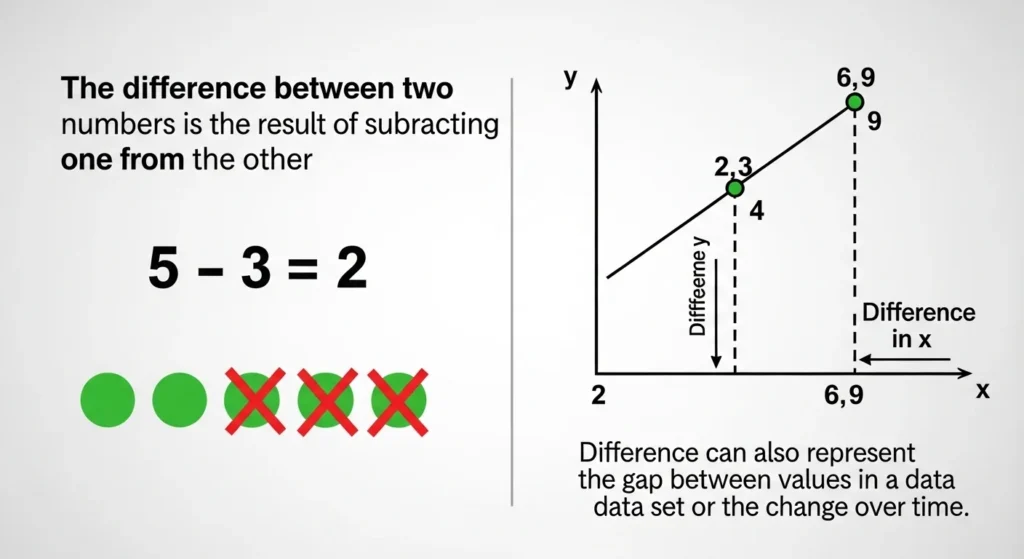
Difference meaning in math is more than just subtracting numbers—it’s a concept that appears everywhere, from basic arithmetic to advanced algebra and statistics. Understanding it can completely change the way you approach problem-solving, comparisons, and real-life calculations. Whether you’re a student trying to ace your next test or just curious about how numbers interact, mastering differences gives you an edge.
In this guide, we’ll break down the difference meaning in math in a simple, engaging way. You’ll discover clear examples, step-by-step explanations, and practical tips to apply in daily life. By the end, you’ll not only understand differences like a pro but also enjoy spotting them everywhere around you! Ready to unlock the secrets of subtraction and beyond? Let’s dive in.
Quick Checklist Before Using the Difference in Math ✅
Before we jump into examples and applications, here’s a quick checklist to keep in mind:
🔹 Identify numbers correctly – Make sure you know which number is being subtracted from which.
🔹 Understand positive vs negative – Differences can be negative if the subtracted number is larger.
🔹 Check units – In real-world problems, make sure your units match (like meters, dollars, etc.).
🔹 Estimate first – Quick estimation helps catch mistakes before calculating.
🔹 Practice with examples – The best way to master difference problems is through repeated practice.
1️⃣ Basic Difference in Arithmetic
The most common use of difference meaning in math is in simple subtraction. Here are some examples:
10 − 4 = 6
25 − 8 = 17
50 − 25 = 25
100 − 40 = 60
7 − 3 = 4
30 − 12 = 18
9 − 9 = 0
15 − 7 = 8
200 − 50 = 150
18 − 6 = 12
45 − 20 = 25
33 − 13 = 20
80 − 30 = 50
60 − 15 = 45
12 − 5 = 7
28 − 8 = 20
75 − 25 = 50
90 − 45 = 45
5 − 2 = 3
1000 − 750 = 250
💡 Engagement Tip: Which subtraction problem do you use most often in daily life?
2️⃣ Difference in Algebra
In algebra, the difference often involves variables:
x − y
2a − 3b
m − n + 5
4p − 7q
(x + 5) − (x − 2)
a² − b²
3x − 2y + z
5m − 3n + 7
(2x + 3) − (x − 1)
6p − 4q
y − 2x + 5
(a + b) − (b − c)
7x − 3y + 2
8m − 5n
(x² + 2x) − (x² − 3x)
3a − 2b + c
(4p + 1) − (2p − 3)
5x − 7y
(x + y) − (x − y)
9a − 4b + 6
💡 Engagement Tip: Try creating your own algebraic difference formula with variables you like!
3️⃣ Difference in Geometry
Difference appears in geometry when calculating distances, angles, or lengths:
Difference between side lengths of a triangle
Difference between radii of two circles
Difference in perimeters of shapes
Difference in areas of squares
Difference between two angles of a triangle
Difference between diameters of circles
Difference between heights of rectangles
Difference in diagonals of parallelograms
Difference in volumes of cubes
Difference in edge lengths of prisms
Difference between circumferences of circles
Difference in side lengths of rectangles
Difference between arcs of a circle
Difference in interior angles of polygons
Difference between longest and shortest sides
Difference in coordinates on a plane
Difference in slopes of two lines
Difference in radius and diameter
Difference in side lengths of trapezoids
Difference between perimeter of circle and inscribed polygon
💡 Engagement Tip: Measure objects around your room and find the difference in their lengths!
4️⃣ Difference in Statistics
In statistics, the difference is used to analyze data points:
Difference between mean and median
Difference between two sample means
Difference between predicted and actual values
Difference between maximum and minimum values
Difference between quartiles
Difference in scores between two groups
Difference between individual data points
Difference in percentages
Difference in rankings
Difference in frequencies
Difference between observed and expected frequency
Difference in survey responses
Difference in test scores
Difference in growth rates
Difference between experimental groups
Difference between population proportions
Difference in cumulative data
Difference between probability distributions
Difference in variance
Difference between outliers and median
💡 Engagement Tip: Check a dataset and see which two numbers have the biggest difference!
5️⃣ Difference in Time Calculations ⏱️
Time problems often rely on calculating the difference between two times:
Difference between 2:00 PM and 3:30 PM = 1.5 hours
Difference between 7:45 AM and 9:15 AM = 1.5 hours
Difference between two dates
Difference between sunrise and sunset
Difference in flight durations
Difference in work shifts
Difference in countdown timers
Difference in class schedules
Difference in arrival and departure times
Difference in minutes between two events
Difference in seconds for races
Difference in years between birthdays
Difference in months for deadlines
Difference in hours of sleep
Difference in appointment times
Difference in TV show durations
Difference in train timings
Difference in game durations
Difference in project deadlines
Difference in online event start times
💡 Engagement Tip: Calculate the difference in your daily routine times today!
6️⃣ Difference in Money Problems 💰
Money calculations often require differences:
Difference between income and expenses
Difference between prices of two products
Difference in budgets
Difference in profit margins
Difference in loan amounts
Difference between savings goals
Difference in discounts
Difference in stock prices
Difference in investments
Difference in tax payments
Difference in rent and mortgage
Difference in salary raises
Difference between two bank accounts
Difference in interest earned
Difference in bills
Difference in charity contributions
Difference in cost of materials
Difference in ticket prices
Difference in online purchases
Difference between actual and estimated costs
💡 Engagement Tip: Find a purchase you made recently and calculate the difference from the original price!
7️⃣ Difference in Science and Physics 🔬
In science, differences help measure changes and results:
Difference in temperature
Difference in speed
Difference in mass
Difference in energy levels
Difference in chemical concentrations
Difference in pressure
Difference in voltage
Difference in resistance
Difference in current
Difference in time intervals
Difference in wavelengths
Difference in frequencies
Difference in gravitational pull
Difference in density
Difference in molecular weights
Difference in volume
Difference in momentum
Difference in acceleration
Difference in force
Difference in position
💡 Engagement Tip: Measure a temperature difference today and note how small differences affect experiments!
8️⃣ Difference in Everyday Life Examples 🌟
Difference between hot and cold drinks
Difference between morning and evening routines
Difference in shoe sizes
Difference in recipe ingredients
Difference in travel distance
Difference in phone storage
Difference in TV screen sizes
Difference in fitness levels
Difference in clothing sizes
Difference in book editions
Difference in ticket classes
Difference in internet speed
Difference in battery life
Difference in music volume
Difference in light intensity
Difference in car speeds
Difference in room temperatures
Difference in shoe colors
Difference in paint shades
Difference in furniture sizes
💡 Engagement Tip: Spot small differences in your surroundings—they’re everywhere!
How We Create Team Names (Step-by-Step Process)
While this isn’t directly math, creating names using differences can be fun:
Identify the theme or context
Choose key words or numbers
Play with opposites or differences
Mix and match terms creatively
Test readability and pronunciation
Pick your favorite and tweak if needed
Tips for Making Your Team Stand Out
Use numbers or mathematical symbols
Incorporate unique words or puns
Keep names short and memorable
Relate the name to your purpose or skill
Avoid common or overused terms
FAQs About Difference Meaning in Math
1. What is the difference meaning in math?
The difference is the result of subtracting one number from another.
2. How do you calculate the difference in subtraction?
Subtract the smaller number from the larger number: 10−4=610 − 4 = 610−4=6.
3. What is a difference in algebra?
It is the result of subtracting one expression from another, e.g., x−yx − yx−y.
4. How is difference used in statistics?
It shows variation, like differences between data points, means, or percentages.
5. Can difference be negative?
Yes, if the number you subtract is larger than the original, the difference is negative.
6. Why is understanding difference important?
It’s essential for calculations, comparisons, problem-solving, and real-life applications.
Conclusion
Understanding the difference meaning in math is foundational for all levels of learning. From simple subtraction to advanced algebra, statistics, and everyday applications, differences help us measure, compare, and make sense of numbers and data. Whether you’re a student, teacher, or just a curious learner, practicing differences sharpens your math skills and logical thinking.
🎯 Ready to try it yourself? Pick some numbers today, calculate their differences, and see how versatile this simple concept really is. Share your favorite examples in the comments below!