
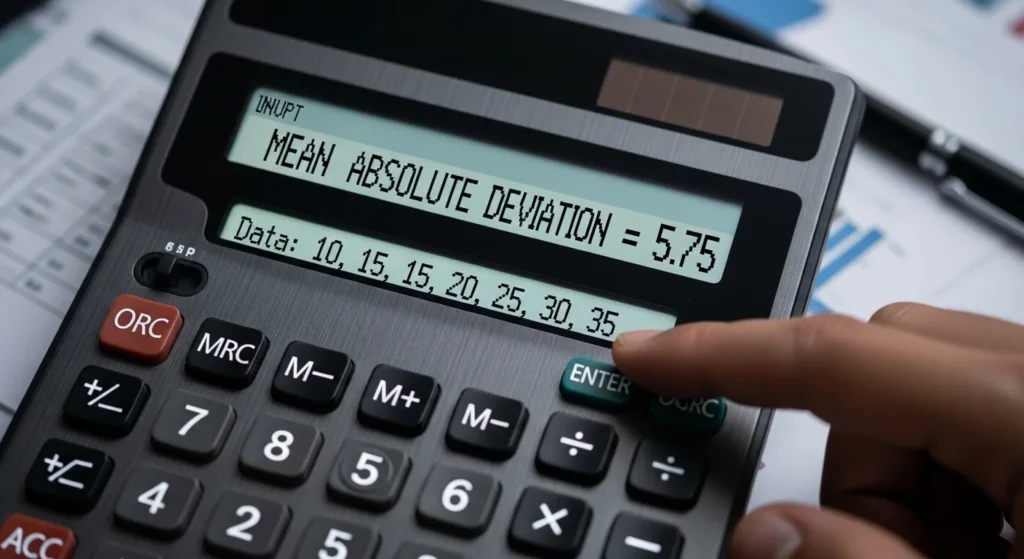
A mean absolute deviation calculator is a simple and powerful tool used to measure how far numbers are from the average in a data set. If you work with math, statistics, finance, or school assignments, this tool makes calculations fast and stress-free.
The mean absolute deviation calculator helps you understand data spread in an easy way. Instead of complex formulas, you can quickly find how much your numbers vary from the mean. In this complete guide, you will learn what it is, how it works, the formula, step-by-step examples, practical uses, and expert tips to calculate it correctly.
Let’s break it down in the simplest way possible.
What Is Mean Absolute Deviation?
Mean Absolute Deviation (MAD) measures the average distance between each data value and the mean (average).
In simple words:
It tells you how spread out numbers are.
If MAD is:
Small → numbers are close to the average
Large → numbers are spread out
It ignores negative signs because it uses absolute values.
Mean Absolute Deviation Formula
The formula for MAD is:
MAD = Σ |xi − x̄| ÷ n
Where:
xi = each value
x̄ = mean (average)
n = total number of values
| | = absolute value
This formula may look complex, but it becomes simple when broken into steps.
How to Use a Mean Absolute Deviation Calculator
You can calculate MAD in 5 simple steps:
Step 1: Find the Mean
Add all numbers and divide by total count.
Step 2: Subtract the Mean
Subtract the mean from each data value.
Step 3: Take Absolute Values
Remove negative signs.
Step 4: Add the Absolute Differences
Add all positive values together.
Step 5: Divide by Total Values
Divide the sum by the number of data points.
That’s it.
Example 1: Simple Data Set
Data:
4, 8, 6, 10, 12
Step 1: Find Mean
(4 + 8 + 6 + 10 + 12) ÷ 5 = 40 ÷ 5 = 8
Mean = 8
Step 2: Differences
4 − 8 = -4 → 4
8 − 8 = 0 → 0
6 − 8 = -2 → 2
10 − 8 = 2 → 2
12 − 8 = 4 → 4
Step 3: Add Absolute Values
4 + 0 + 2 + 2 + 4 = 12
Step 4: Divide
12 ÷ 5 = 2.4
Final Answer:
MAD = 2.4
Why Use a Mean Absolute Deviation Calculator?
Here’s why this method is useful:
✔ Easy to understand
✔ Faster than standard deviation
✔ Good for basic data analysis
✔ Perfect for school students
✔ Helps compare consistency
It gives a clear picture of data spread without complex math.
Mean Absolute Deviation vs Standard Deviation
Many people confuse these two.
Mean Absolute Deviation:
Uses absolute values
Easier to calculate
Simple interpretation
Standard Deviation:
Uses squared differences
More sensitive to extreme values
Used in advanced statistics
For basic analysis, MAD is often enough.
When Should You Use It?
You can use a mean absolute deviation calculator in:
📊 Statistics homework
📈 Business reports
💰 Financial analysis
🏫 Classroom projects
📉 Comparing test scores
📦 Quality control
Any time you need to measure variability.
Common Mistakes to Avoid
Forgetting to divide by total values
Not using absolute values
Wrong mean calculation
Mixing it with range or variance
Rounding too early
Always double-check your mean first.
How to Calculate Mean Absolute Deviation Quickly
If you want speed:
Use a calculator for sums
Write numbers in a table
Keep values organized
Double-check subtraction
Practice makes it faster every time.
Benefits of Using an Online Mean Absolute Deviation Calculator
Online tools offer:
⚡ Instant results
📱 Mobile-friendly access
🧮 Error-free calculation
⏳ Time saving
📊 Large data handling
They are perfect when working with big data sets.
Real-Life Example
Imagine student test scores:
70, 75, 80, 85, 90
Mean = 80
Differences:
10, 5, 0, 5, 10
MAD = (10 + 5 + 0 + 5 + 10) ÷ 5
MAD = 30 ÷ 5
MAD = 6
This tells us scores are on average 6 points away from the mean.
Advanced Example with Decimals
Data:
2.5, 3.5, 4.0, 5.5
Mean:
(2.5 + 3.5 + 4.0 + 5.5) ÷ 4
= 15.5 ÷ 4
= 3.875
Now calculate deviations carefully and divide.
This works the same way for decimals.
How Teachers Use Mean Absolute Deviation
Teachers use it to:
Compare student performance
Measure score consistency
Analyze grading fairness
Evaluate improvement trends
It is simple and practical in education.
How Businesses Use It
Businesses use MAD to:
Track sales stability
Monitor product performance
Analyze cost variation
Improve forecasting accuracy
It helps understand fluctuations.
Tips for Accurate Calculation
Always calculate mean correctly
Keep numbers organized
Use parentheses carefully
Double-check division
Avoid rounding too early
Accuracy matters in statistics.
Frequently Asked Questions
What does a mean absolute deviation calculator do?
It calculates the average distance between each value and the mean in a data set.
Is mean absolute deviation hard?
No. It is one of the easiest measures of variability.
Can MAD be negative?
No. Absolute values make it always positive or zero.
What is a good MAD value?
Smaller values mean more consistent data. There is no fixed “good” number.
Is it better than standard deviation?
It depends. MAD is simpler. Standard deviation is more precise for advanced analysis.
Can I calculate it manually?
Yes. Just follow the formula step by step.
Final Thoughts
A mean absolute deviation calculator is a powerful yet simple way to measure how spread out your data is. It helps students, teachers, analysts, and businesses understand variability without complex math.
Now you know:
What it means
The formula
Step-by-step calculation
Real-life examples
Common mistakes
Practical uses
If you have a data set ready, try calculating it now. Or share your numbers, and I’ll calculate the MAD for you instantly. 😊